My team planned to manufacture our wings for our entry into SAE Aero Advanced Class 2026 out of EPS foam. We had cut wings by hand with a template, but it was slow and prone to errors. We wanted to be able to iterate quickly but also to reduce the waste foam we created, as EPS foam isn’t exactly environmentally friendly. We had also expressed interest in the past in having a CNC foam cutter, and, during a lull early in the project, I set a week or two aside to work on this.
Design
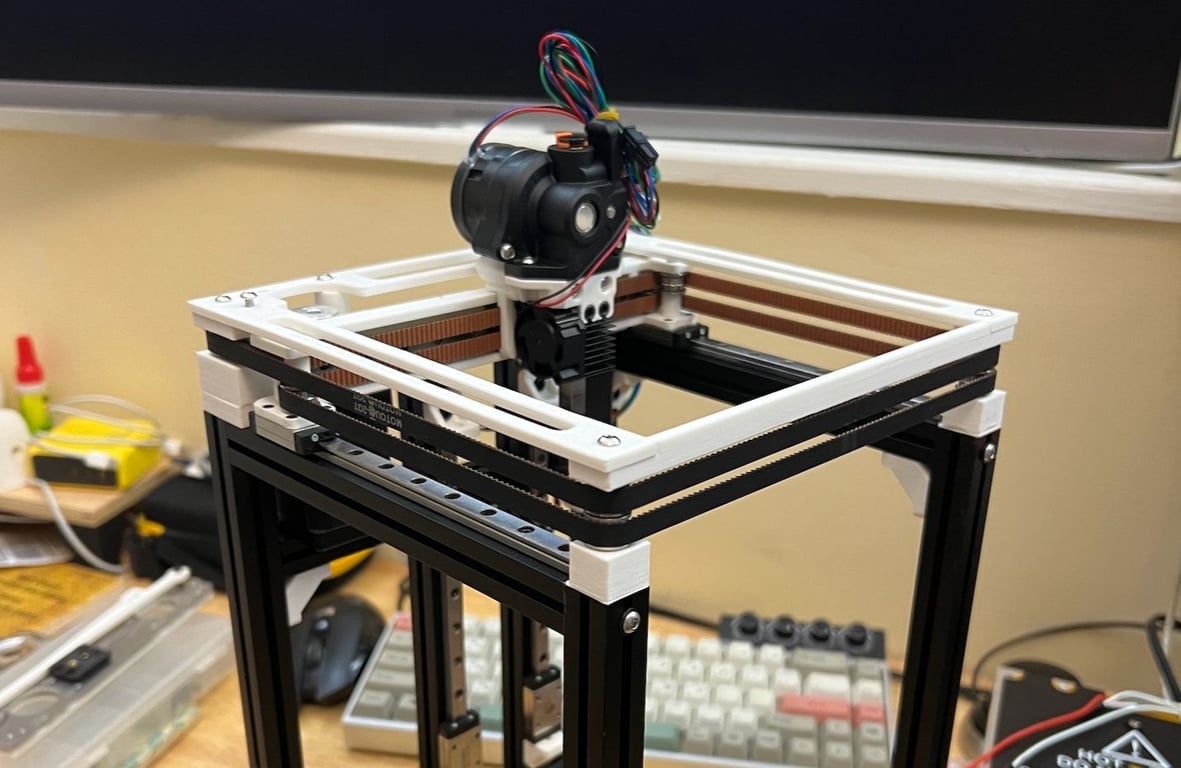
The machine is made of scrap parts from two Ender 3 and CR-10 3D printers that had been previously disassembled for other projects, as well as a newly-purchased BTT SKR MINI control board. I found an existing project by rcKeith that handled the firmware and software control, so all that was left was assembly. Using existing CAD files for the Ender 3, I was able to create some simple parts that allowed me to convert the printers to a foam cutter.
The design re-uses the X axis from the Ender 3, with modifications to the gantry, plus the large frame rails from the CR-10. The right side uses mirrored 3D printed versions of X-axis made by the community. The vertical axis plates, belt holders, and wire tensioners are my designs, as are the mounting brackets for the 8020 extrusion.
Slotted mount attaches belts to vertical axis plate
Tensioner provides ~1in of extension each side
Conclusions & Takeaways
This project was a lesson in restraint. Our team didn’t need a perfect product, they just needed something good enough. It also couldn’t take too much time away from the rest of the project, which was far more important. I could have designed the gantry parts from scratch, but since we already had the leftover parts, why not use those? While this wouldn’t fly as a production product, it’s a perfectly functional machine for club and capstone teams going forward. And using existing software means that references are easily available should anyone want to tune or modify it in the future. I was able to use my CAD experience to quickly make new parts and modify existing ones before 3D printing and laser cutting them out. The majority of one of the weeks was battling with firmware on an outdated board before switching to the SKR Mini board. In that case, buying a new (but still very inexpensive) board helped the process go more smoothly overall. The only thing I’d change about this going forward was buying that board sooner.
Gallery
Test airfoil cut with the foam cutter. Those slots in the top would later be fixed in place with epoxy.
OnShape Assembly of the foam cutter to check mechanics and range of motion before building
An ultra-compact CoreXY 3D printer design with a 35% smaller footprint and 50% smaller overall volume than the Voron V0 with the same usable print size